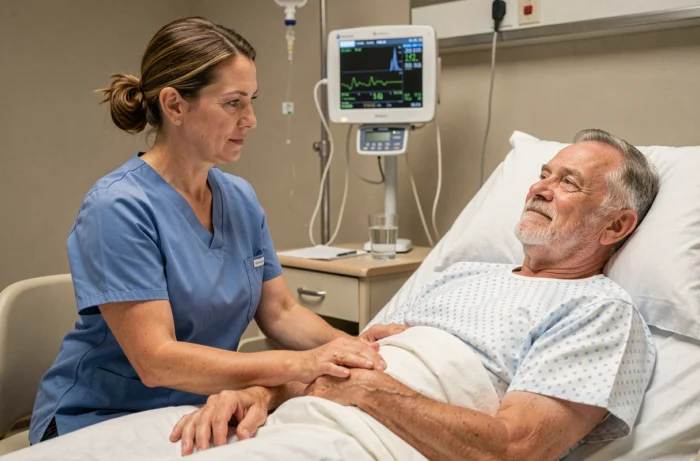
A patient arrives at the emergency room with chest pain rated 8 out of 10. The nurse assesses, the doctor prescribes, and the physiotherapist will intervene later. Among these three professionals, the transmission of information about pain often relies on heterogeneous practices, scales used differently, and a lack of coordination that delays relief. Pain management is not only about choosing the treatment but also about the teams’ ability to share a common framework.
Pain Assessment: The Weak Link Remains the Shared Tool
On the ground, it is observed that pain assessment varies depending on the department, the professional, and sometimes the time of day. A nursing assistant in geriatrics does not use the same scale as a nurse in outpatient surgery, and the results are not always recorded in the same place in the patient file.
The problem is not the absence of tools. Scales exist: VAS, NRS, Algoplus for non-communicative patients. The problem is their inconsistent use from one professional to another. When a doctor receives a pain rating without knowing which scale was used or when, the therapeutic decision relies on fragile data.
For a healthcare team to be truly effective in managing pain, the assessment protocol must be identical at every stage of the care pathway. This requires common training, not just the dissemination of an internal document that no one reviews after the first week. More information can be found on Mon Coach Douleur to equip teams in this standardization process.
Graduated Organization of Chronic Pain Management in France
The Haute Autorité de Santé has structured chronic pain management according to a graduated organization in three levels. This structuring concretely modifies how caregivers direct patients and coordinate their interventions.
First Line Care in the Community
The general practitioner remains on the front line. They conduct the initial standardized assessment and implement a multidisciplinary treatment that may involve a physiotherapist, psychologist, and pharmacist. In practice, it is at this stage that many chronic pains stagnate due to a lack of coordination among these professionals.
Second Specialized Care and Certified Structures
When the pain persists or becomes more complex, the patient is referred to a specialized pain consultation. Coordination between community and hospital care is strengthened at this level. For the most complex situations, specialized chronic pain structures (certified centers and consultations) take over with an in-depth multidisciplinary approach.
This gradation assumes that each professional knows precisely when to refer. A general practitioner who keeps a chronic pain patient too long without results delays access to secondary care. A hospital specialist who does not refer back to the community after stabilization congests the structures.
Non-Pharmacological Techniques: What Changes in Healthcare Training
There is an increasing emphasis on non-pharmacological approaches in continuing education programs. Medical hypnosis, for example, is now the subject of recognized university diplomas, such as those offered by CNAM or the University of Strasbourg on pain management through hypnosis.
This is not a passing trend. Non-pharmacological techniques complement traditional analgesic treatment and sometimes reduce the need to resort to higher levels. In palliative care, pediatrics, and geriatrics, these approaches concretely change the patient’s experience.
On the ground, feedback varies depending on the teams and care contexts. Some services integrate relaxation or music therapy into their daily protocols, while others struggle to free up care time for these interventions. Training alone is not enough: there needs to be a work organization that makes these practices possible on a daily basis.
- Medical hypnosis is the subject of dedicated DU programs in several French universities, with specific modules on acute and chronic pain.
- Sensory stimulation (relational touch, music therapy) is gradually being integrated into care projects in geriatrics and palliative care.
- Mind-body approaches (mindfulness meditation, guided relaxation) are increasingly documented and taught in continuing education programs.
The Role of the Nurse in Identifying and Communicating Pain
The nurse is the healthcare professional who spends the most time in contact with the patient. They are the ones who identify signs of pain between medical visits, adjust the timing of analgesic administration, and alert when a treatment is not working.
The law of March 4, 2002, established that relieving pain is a fundamental right of the patient. In practice, this translates into an obligation for traceability: each assessment must be recorded, and each change in painful behavior noted. The nurse does not merely execute a prescription; they actively participate in adjusting the analgesic protocol.
A often underestimated point concerns pain induced by the care itself. Dressings, punctures, mobilizations: these actions generate predictable pain that can be anticipated. Preventing pain induced by care reduces patient anxiety and improves their cooperation for the continuation of treatment.
- Systematically assess pain before and after each potentially painful procedure, using the scale appropriate for the patient.
- Apply anticipated analgesic protocols (premedication, local anesthesia) according to current prescriptions.
- Communicate observations in a structured manner in the care file to ensure continuity between teams.
Supporting healthcare professionals in pain management means first providing them with the concrete means to assess, communicate, and coordinate. Digital tools, multidisciplinary training, and the graduated organization established by the HAS outline a framework. It remains for each team to take ownership of it, starting with harmonizing what happens at the patient’s bedside.