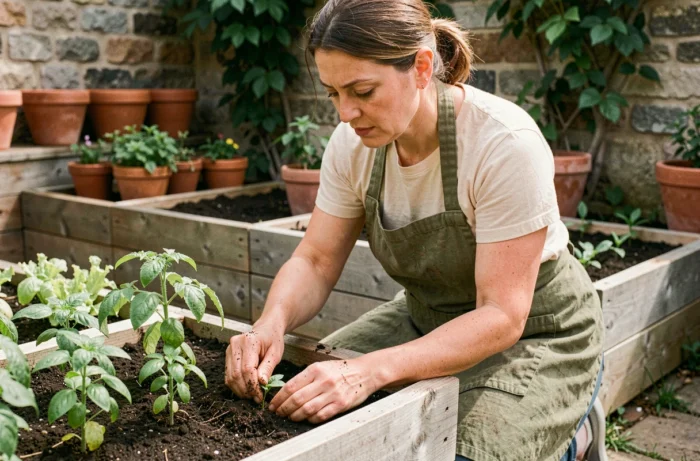
A productive vegetable garden relies on living soil, a calendar adapted to the local climate, and coherent crop choices. Succeeding in your vegetable garden does not require more space, but a better understanding of the terrain and the actual growth conditions of the plants.
Sunken garden: an alternative to raised beds to save water
The raised bed has dominated tutorials for years. It drains well, limits back pain, but exposes the soil to rapid drying from the side walls and the surface exposed to the wind.
A recent approach reverses the logic: the sunken garden, where the growing area is excavated fifteen to thirty centimeters below the level of the surrounding soil. Rainwater and irrigation naturally converge towards the roots instead of running off. In a dry summer, the frequency of watering can be reduced by two or three times compared to a raised bed, according to feedback shared by amateur gardeners.
To learn more about varieties suited to this type of cultivation, the catalog of Graine de Jardinier offers seeds selected for their drought resistance and suitability for family gardens.
The sunken garden is especially suitable for well-drained soils (sandy, loamy-sandy). On clay soil, the risk of winter waterlogging is real: it is better to combine a slight excavation with drainage at the bottom of the sunken area (gravel or brushwood fascines).
Mulching and shade nets: protecting crops from heat spikes
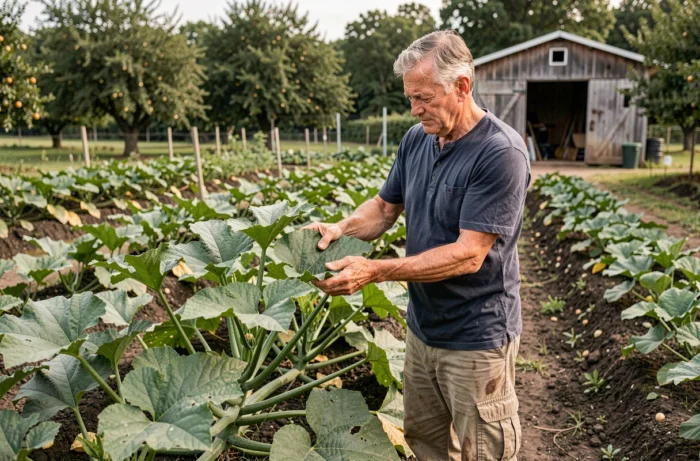
Many vegetable gardens remain visually green in the middle of summer but produce little. Tomato flowers drop, fruits stagnate, and foliage wilts. This phenomenon is explained by the closure of stomata: beyond a certain heat threshold, the plant blocks its gas exchanges to limit water loss, which halts photosynthesis and thus growth.
Three actions can help limit this blockage:
- Apply a thick mulch on previously moistened soil, never on dry soil (the mulch would then isolate dryness instead of retaining moisture).
- Water exclusively during cool hours, early morning or evening, at the base of the plants and not by foliar spraying.
- Install lightweight shade nets, providing about twenty to forty percent shade, sufficient to lower the temperature at the leaf level without depriving crops of light.
Mulching is not limited to wheat straw. Dried grass clippings, shredded leaves, ferns: each material has a different carbon/nitrogen ratio. Fresh clippings, rich in nitrogen, can form an impermeable crust if laid too thickly. Spreading them in a thin layer and allowing them to dry before piling them up avoids this issue.
Crop rotation in the vegetable garden: reasoning by botanical families
Rotation is not just a simple habit of old gardeners. Growing the same family of vegetables in the same spot for two consecutive years depletes the soil of specific nutrients and encourages the accumulation of pathogens in the soil.
The operational principle is based on four main families to rotate:
- Solanaceae (tomatoes, peppers, eggplants, potatoes): heavy consumers of potash and sensitive to blight.
- Fabaceae (beans, peas, broad beans): they fix atmospheric nitrogen in the soil through their root nodules, enriching the plot for the next crop.
- Cucurbitaceae (zucchini, squash, cucumbers): large consumers of nitrogen and water.
- Apiaceae and Alliaceae (carrots, onions, garlic, leeks): less demanding, they serve as a “break” for the soil.
The practical rule: do not plant a family in the same plot for at least three years. In a small vegetable garden, dividing the space into four zones and rotating each group from one zone to another each year is enough to maintain balanced soil.
Sowing and calendar: adapting dates to the real climate, not the theoretical calendar
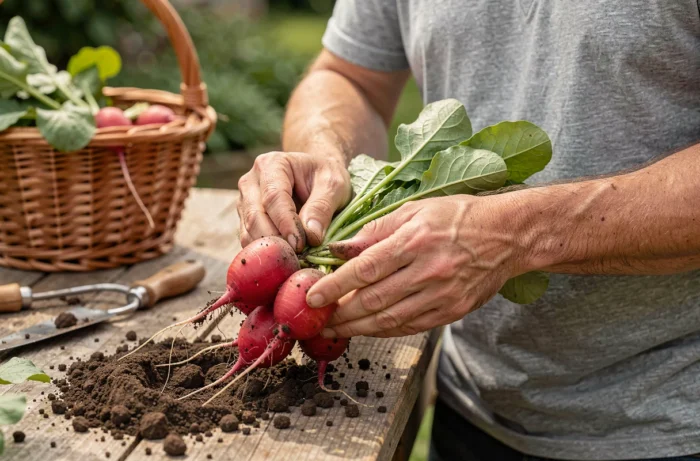
The sowing calendars printed on seed packets indicate national ranges that do not take local specifics into account. Sowing tomatoes in the ground too early in a region prone to late frosts produces weak plants that will take weeks to catch up with a plant sown later under good conditions.
The most reliable reference remains the soil temperature, not the air temperature. Most common vegetables germinate poorly below twelve degrees at the root level. A simple soil thermometer, planted five centimeters deep in the morning, provides a much more useful indication than the calendar date.
For spring sowing, waiting for the soil to warm up over several consecutive days avoids irregular germination and seed loss. In autumn, the logic reverses: sowing green manures (mustard, phacelia) as soon as the plots become available protects bare soil from winter erosion and prepares the soil structure for the following spring.
Green manures and winter soil cover
Bare soil in winter compacts under rain, loses its nutrients through leaching, and sees its microbial life decline. Covering each released plot is the most cost-effective action for the following season. Phacelia, sown in September, naturally freezes in winter and leaves a mulch that earthworms incorporate into the soil without additional work.
The choice of green manure depends on what will be grown next: a legume before solanaceae enriches the plot with nitrogen at the right time, while a crucifer (mustard) before cabbages would be counterproductive since it belongs to the same family.
The success of a vegetable garden is determined more by what happens below the soil surface than above it. A well-covered, properly mulched, and rigorously rotated plot produces healthy vegetables with less watering and without resorting to treatments.