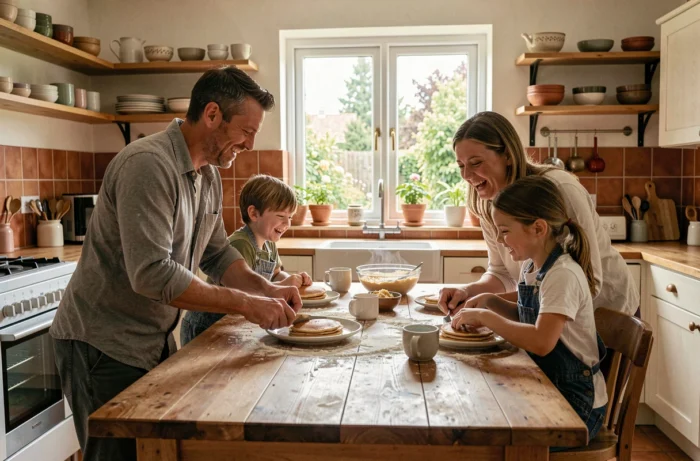
Families that function daily do not follow a single model. They tinker, adjust, and give up certain ambitions to preserve others. A fulfilling family life does not rely on a perfect schedule, but on repeated choices, sometimes tiny, that take into account fatigue, irregular hours, and the reality of screens in every room of the house.
Family Space Arrangement: Reducing Tensions Effortlessly
One of the least discussed levers for improving family daily life concerns the physical organization of the home. Before trying to change the behaviors of children or parents, it is often more effective to modify the environment in which these behaviors occur.
An accessible reading nook, child-height storage, a retreat space where everyone can isolate themselves for a few minutes: these concrete adjustments reduce sources of daily friction. When a child can grab their book or put away their toys by themselves, the “request-frustration-conflict” loop is cut off at the root.
Regular decluttering contributes to this logic. Fewer objects in shared spaces mean fewer disputes over tidying up, less time wasted searching, and smoother circulation in morning or evening routines. Resources like the family page of Maman Zen detail several approaches to rethink home organization with young children.
Predictable Routines and Family Stress: What Regularity Really Changes
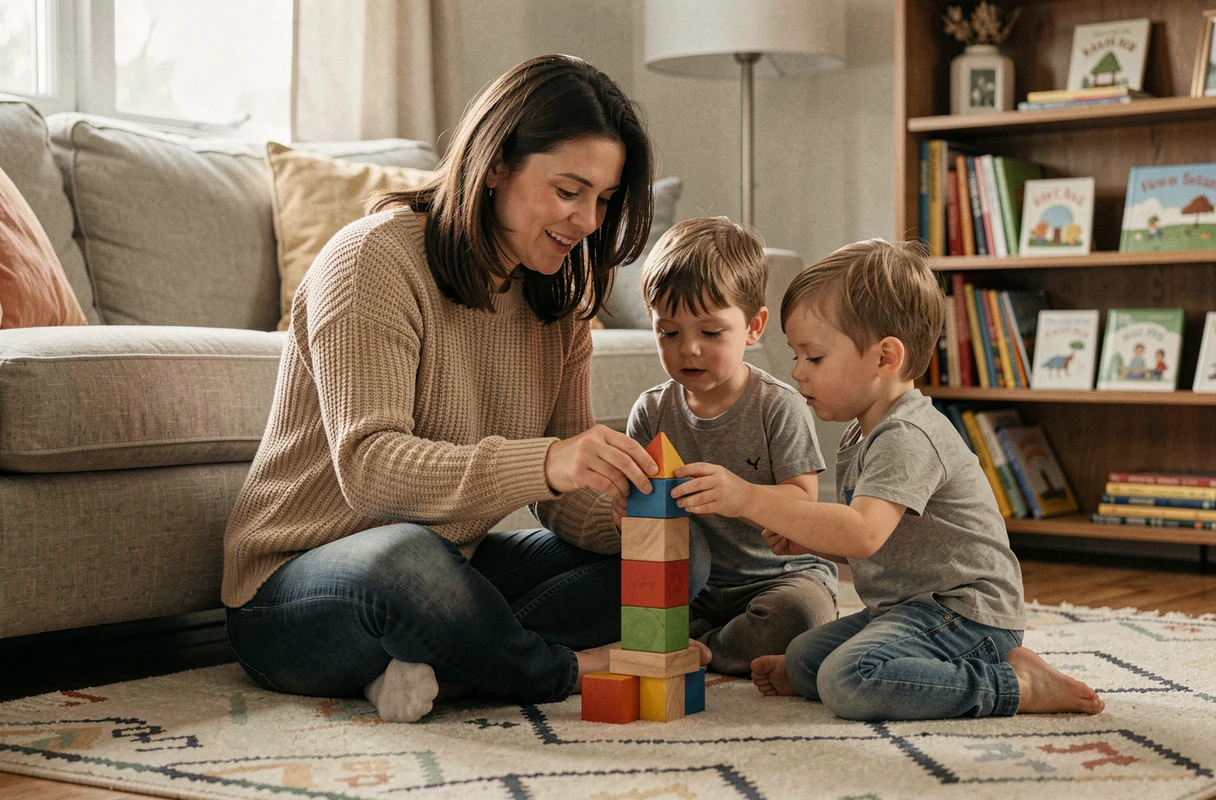
Predictable routines appear as a factor of intergenerational calm. Consistent meal times, bedtimes, and quiet times reduce anxiety related to the unknown, even in older children who seem autonomous.
This does not mean rigidity. An effective routine tolerates exceptions without collapsing. Tuesday’s meal can be shifted if a parent comes home late. The bedtime ritual can be shortened on a night of fatigue. What matters is that the framework remains identifiable for the child.
What a Realistic Routine Contains
- A stable time marker for the main family meal, even if the menu varies or if a parent is absent
- A clear signal for transitioning to bedtime (dimmed lights, story, song) rather than a fixed time on the clock
- A designated time slot during the week when no one has obligations, without scheduled activities or screens
Field reports vary on the time needed for a routine to settle in. Some families notice an effect in a few days, others in several weeks. The consistency of the framework seems more decisive than its sophistication.
Screens and Family Life: Replacing Prohibition with Alternatives
Prohibiting screens often generates more conflicts than exposure itself. Exhausted parents know this: a rule that cannot be applied consistently produces guilt in the adult and frustration in the child.
A shared physical activity slot can reduce screen time without resorting to outright prohibition. A walk after dinner, a ball game in the garden, or a dance session in the living room occupy the same time slot as the tablet, but without the power struggle.
The goal is not to eliminate screens from family life. It is to create moments that are attractive enough so that the screen is no longer the default choice. When the time shared between parents and children is filled with a concrete activity, the issue of screens loses its intensity.

Screens and Parental Couple
The topic of screens also concerns adults. A parent checking their phone during a meal sends a contradictory signal. Putting the phone in a drawer upon returning from work, even for half an hour, creates a space of attention that benefits all family members.
Ritualized Exchange Time: Structuring Communication in the Family
Families where everyone feels heard are not those where people talk the most, but those where communication is distributed predictably. A weekly meeting, without screens, where everyone can express one satisfaction and one difficulty from the week, is enough to diffuse accumulated tensions.
Rephrasing plays a key role in these exchanges. When a child says, “this is stupid, no one listens to me,” rephrasing it as “you feel like we are not paying attention to what you say” changes the dynamic. The child feels understood. The parent avoids escalation.
- Choose a fixed time (Sunday morning, Wednesday evening) for a short “family council”
- Use a talking object for younger ones, so everyone waits their turn
- Limit the duration to about twenty minutes to keep this time enjoyable and not burdensome
These ritualized exchanges prevent the escalation of conflicts much more effectively than an improvised discussion during a crisis. The calm framework allows for addressing topics that, when heated, can escalate.
Couple and Parenting: Preserving Space for Two
Couple life does not disappear with the arrival of children, but it changes form. Moments of love and connection often come through micro-slots: a ten-minute conversation after the children are in bed, a shared coffee in the morning before the collective wake-up.
The parental couple needs moments without parental function. Talking about the children does not count as couple time. Discussing oneself, one’s desires, and anything unrelated to the house or the children’s activities: this is what maintains the bond.
The available data does not allow for setting an ideal frequency for these moments. Some families operate with a monthly evening for two, others with five minutes of real connection daily. The intensity of attention matters more than the duration.
A fulfilling family life is built through continuous adjustments, not by a fixed method. Arranging space, stabilizing a few routines, offering alternatives to screens, and ritualizing exchanges: these four axes cover most of the daily frictions of parenting. The rest belongs to each family, according to its constraints, schedules, and current energy levels.