
The iPhone 7 and iPhone 7 Plus share the same launch year and the same Apple A10 Fusion processor. However, their differences stem from design choices that, depending on the intended use, clearly influence the decision. The context has also changed: these two models are now locked to iOS 15, which redefines their relevance in the second-hand market.
Software support and security: the real ceiling for these two models
Before comparing screen, sensor, or battery life, one fact weighs heavier than all others. The iPhone 7 and iPhone 7 Plus no longer receive iOS updates since iOS 15. Neither will access iOS 16 or later versions.
This limitation has direct consequences. Some recent applications now require iOS 16 or higher to function. Security patches are no longer distributed regularly, exposing these devices to known vulnerabilities.
On this specific point, choosing the 7 or the 7 Plus makes no difference: both share exactly the same software deadlock. The question then becomes one of the residual use that can be derived from them, and this is where the hardware differences regain importance. A detailed comparison of these differences is also offered for those who are hesitating between the iPhone 7 or 7 Plus on La Ligne d’Horizon, with a complementary angle on everyday usage.
Dual camera of the iPhone 7 Plus: a still useful advantage
The iPhone 7 has a single rear sensor. The iPhone 7 Plus features a dual sensor combining wide-angle and standard focal length. This system allows for a 2x optical zoom and a digital zoom of up to 10x.
Both models benefit from optical image stabilization and an aperture of f/1.8. However, only the 7 Plus offers a portrait mode with depth effect, made possible by the combination of its two lenses.

For limited use on social media or messaging, the single sensor of the 7 is more than sufficient. The dual sensor of the 7 Plus is only justified if optical zoom or portrait mode are part of your photographic habits. On a device that will no longer receive software updates for image processing, photo quality relies entirely on the built-in hardware.
Screen size and bulk: a very personal trade-off
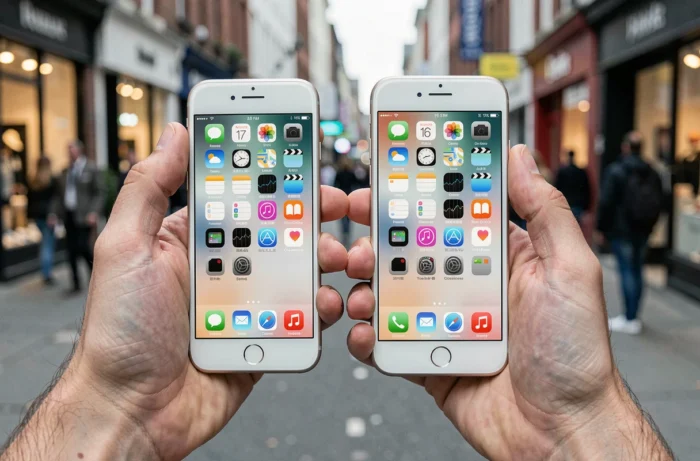
The iPhone 7 offers a 4.7-inch screen. The 7 Plus increases to 5.5 inches. This difference may seem modest on paper, but it significantly alters the user experience.
The 7 Plus provides more comfort for reading, web browsing, and watching videos. Its larger display shows more content without scrolling. In return, it is considerably less manageable with one hand and heavier in your pocket.
A often overlooked point concerns fragility. A larger smartphone statistically increases the risk of drops. On an older model where spare parts are becoming rare in the second-hand market, a broken screen can make repairs unfeasible.
- iPhone 7: compact format, one-handed use, discreet in pocket, suitable for simple uses (calls, messaging, light browsing).
- iPhone 7 Plus: more comfortable screen for multimedia, but increased bulk and uncertain repairability.
- In both cases, check the condition of the chassis before purchase: a model already weakened by previous impacts will be difficult to repair at a reasonable cost.
Battery life and health: the decisive criterion in 2026
The battery of the 7 Plus offers a higher nominal capacity than that of the 7. In daily use, this translates to an additional one to two hours of screen time under normal conditions.
However, this difference in capacity tells only part of the story. On a device that has several years of use, the actual health of the battery matters more than its original capacity. An iPhone 7 Plus with a battery degraded to less than 80% of its maximum capacity will lose its battery life advantage over an iPhone 7 whose battery has been recently replaced.
Before any second-hand purchase, check the battery health indicator in the settings. A device listed at a low price with a heavily worn battery is not a good deal: replacing the battery by a third-party repairer adds a significant cost, and the availability of compatible batteries decreases over time.
iPhone 7 or 7 Plus in 2026: for which user profile
The value-for-money ratio has evolved. The iPhone 7 remains the most economical option for strictly basic use: calls, SMS, light web browsing, and a few messaging applications still compatible with iOS 15.
The 7 Plus is only justified for three specific reasons:
- You value optical zoom and portrait mode for photography.
- You regularly watch videos on your phone, and screen size makes a real difference for you.
- You find a unit with a battery in excellent condition, which restores its battery life advantage.
Outside of these cases, the extra cost of the 7 Plus in the second-hand market only offers a marginal gain. Both models share the same software limitation, the same processor, and the same lack of security updates. For a backup or emergency phone, the 7 fulfills the contract at a lower cost. For primary use in 2026, neither is a sustainable choice compared to newer models still supported by Apple.