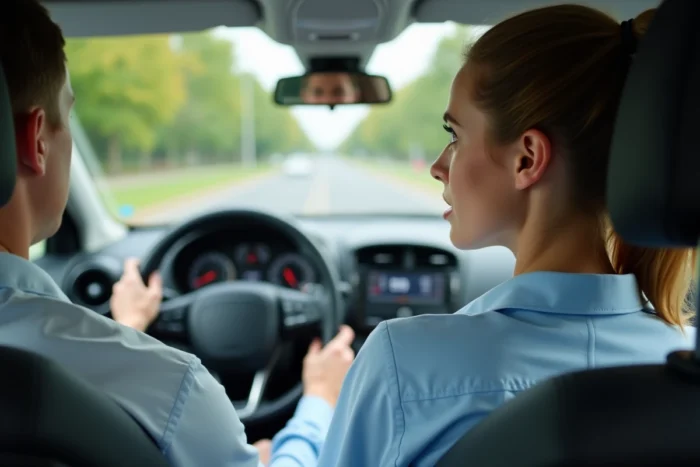
In France, the pass rate for the practical driving test varies by department, type of training, and candidate profile. Driving schools offer standardized courses, but the reality of learning differs depending on whether one takes the test at 18 without particular pressure or after several failures, with established stress. Mental preparation, long relegated to the background, is now recognized as a direct factor in performance on the day of the exam.
Adapting Driving Test Preparation to the Candidate’s Profile
The online resources available treat driving test preparation as a unique journey. All candidates would receive the same advice: go to bed early, revise the code, don’t stress. This approach ignores the real differences between profiles.
A candidate retaking the exam after one or two failures is not in the same situation as a first-time candidate. Repeated failure establishes defensive habits: excessive early braking, hesitation at intersections, a fixed gaze. To remedy this, taking a few targeted driving hours focused on specific failure points (maneuvers, merging, priority management) yields better results than simply “doing more hours.”
The choice between manual and automatic transmission also deserves to be addressed frankly. A candidate who frequently stalls on a hill or struggles with the biting point accumulates mechanical stress that disrupts their driving in traffic. Switching to automatic transmission training reduces cognitive load and allows for better focus on road reading, visual checks, and anticipation.

Conversely, a candidate comfortable with the clutch but paralyzed by the examiner’s gaze falls into a different category. For this profile, it is the emotional component that hinders performance, not the technique. Several field reports converge on this point: working on abdominal breathing and simulating exam conditions (presence of an unknown third party in the vehicle, unprepared route) helps desensitize the stress response.
This idea of differentiating preparation based on the candidate’s actual difficulties rather than applying a uniform recipe is also found among Net Actu’s driving test tips.
Mental Preparation and Stress Management for the Driving Test
The stress on the day of the exam is not just a discomfort. It concretely alters driving: narrowed field of vision, prolonged reaction time, forgetting mirror checks. These effects are sufficient to turn a competent candidate into a failed one.
Mental preparation directly influences the final score. This observation, shared by several specialized sources, goes beyond the simple “relax.” It involves establishing a routine before the test.
- Arrive at the exam location at least twenty minutes early to acclimate to the environment and avoid logistical stress (traffic jams, hard-to-find parking).
- Practice a few cycles of slow abdominal breathing (inhaling through the nose, long exhaling through the mouth) in the vehicle before departure to lower the heart rate.
- Mentally recall three or four technical points mastered rather than listing weaknesses, to start with a confidence anchor.
Field reports vary on the usefulness of driving the day before the exam. Some instructors recommend a last short session to “keep the hand,” while others believe that a full day of rest reduces accumulated fatigue. No universal rule applies: the choice depends on the candidate’s level of anxiety and learning pace.
Eliminatory Faults in the Driving Test: Understanding the Scoring System to Drive Better
Many candidates focus on the score without understanding what determines it. The practical driving test relies on an evaluation grid where each skill (installation, starting, trajectory, speed, communication with other road users) is observed by the examiner throughout the course.
One single eliminatory fault is enough to fail the exam, regardless of the overall level of performance. These faults concern dangerous behaviors: crossing a solid line, running a red light, blatant speeding, endangering a pedestrian or cyclist. They cannot be compensated for.
Tolerated errors, on the other hand, are more numerous than one might think. Stalling at the start, a slightly wide trajectory in a turn, a momentary forgetfulness of the turn signal are not disqualifying if the rest of the driving shows a consistent understanding of traffic rules. The examiner evaluates the ability to drive safely, not a flawless performance.
Knowing this distinction changes the way to prepare. Rather than aiming for technical perfection in every gesture, it is better to consolidate the fundamentals that protect against eliminatory faults:
- Systematic visual checks before every change of direction or lane (mirrors, blind spots).
- Strict adherence to signage (lights, stops, right of way) without risky anticipation.
- Adapting speed to the environment: school zones, wet roads, reduced visibility.
- Maintaining a sufficient safety distance from the vehicle ahead.
Online Training vs. Traditional Driving School: What the Format Really Changes
Online platforms for highway code training have multiplied. They offer thematic courses, timed question series, and statistical tracking of results. For the theoretical part, this format suits autonomous candidates who are consistent in their work.
For driving, the question arises differently. Online driving schools connect candidates with independent instructors. The learning vehicle may vary from lesson to lesson, as may the instructor. The educational continuity then depends on the candidate, who must ensure their own progress tracking.
In a traditional driving school, the instructor knows the candidate’s habits, recurring weak points, and progress. This ongoing relationship facilitates lesson adjustments. However, the wait times to secure an exam slot may be longer depending on geographical areas.
The choice between these two formats is not a matter of absolute quality. An organized candidate, comfortable with digital tools and capable of structuring their own revisions will benefit from online training. A candidate who needs regular structure and personalized support will gain from staying in a traditional path.
The driving test remains an exam where technique and mindset weigh equally. Identifying one’s own blockages, whether mechanical, regulatory, or emotional, before multiplying driving hours remains the most effective approach to aim for a high score.