
Arranging, renovating, or decorating a home on a daily basis relies on concrete decisions. Which areas of work offer the best return in comfort? Which decorative choices withstand trends without breaking the budget? This article intersects thermal priorities, modular design trends, and measurable decorative levers to guide every decision.
Thermal Renovation and Decoration: A Priority Order That Changes Everything
The temptation to start with paint or furniture is strong. Technical logic imposes a different sequencing: address the thermal envelope before decorative finishes. Insulate the attic, then the walls, correct air leaks, replace windows, and only then choose colors or coverings.
This sequencing avoids dismantling freshly applied finishes to run ducts or inject insulation. It also ensures that decorative materials (plasters, wallpapers, floors) do not suffer from condensation due to residual insulation defects.
The current recommendation structures renovation around three axes: winter comfort, summer comfort, and indoor air quality. Starting with a simple diagnosis of losses (attic, walls, floors, infiltrations) allows for prioritizing projects and avoiding premature decorative expenses. On the home pages of Mon Blog Habitat, several field reports illustrate this step-by-step approach.
| Renovation Item | Impact on Daily Comfort | Effect on Decoration |
|---|---|---|
| Attic Insulation | Notable reduction in thermal losses | No visible impact, frees up the decorative budget |
| Window Replacement | Immediate acoustic and thermal comfort | Changes the style of openings, frames natural light |
| Ventilation (double-flow VMC) | Air quality, reduction of humidity | Protects wall coverings and paints |
| Painting and Coverings | Low thermal impact | Strong visual transformation, to be done last |

Modular Design: Adapting the Room to Use, Not the Other Way Around
The interior decoration market is reconfiguring around a realization: living spaces are shrinking, and remote work imposes multiple uses in the same room. Fortune Business Insights highlights the rise of modular furniture and flexible layouts in residential spaces.
A living room that also serves as an office three days a week cannot be decorated like a pure living room. The choice of furniture becomes a functional decision before being aesthetic.
Concrete Criteria for Multifunctional Layout
- Favor double-function furniture (foldable desk integrated into a bookshelf, extendable table that goes from 4 to 8 seats) to limit permanent clutter.
- Create micro-zones on the floor rather than with partitions: a rug delineates the office space, a different covering marks the dining area. This approach preserves the flow of natural light.
- Incorporate closed storage at height (columns, wall shelves with doors) to absorb work materials at the end of the day and visually restore a living space.
This modular logic has a direct effect on decoration: it leans towards neutral palettes and natural textures that tolerate the coexistence of functional objects (screen, printer) with decorative elements (plants, frames, ceramics).
Biophilic Design in Daily Life: Plants, Light, and Natural Materials
Biophilic design goes beyond the mere presence of green plants on a shelf. It structures the relationship between the occupant and their environment around three levers: living plants, natural light, and raw materials.
Natural light remains the primary factor of perceived comfort in a room. Before buying a designer light fixture, checking that windows are not obstructed by opaque curtains or tall furniture placed in front of openings produces an immediate and free effect.
Sustainable Materials and Decor: A Choice That Lasts
Fortune Business Insights notes a growing demand for sustainable materials in residential decoration: recycled wood furniture, low-energy lighting, textiles made from natural fibers. These choices are not solely based on an ecological stance. A piece of recycled solid wood furniture ages better than a melamine particle board and withstands multiple renovation cycles without replacement.
Investing in a sustainable material reduces decorative costs over ten years, even if the initial purchase price is higher. A solid oak countertop can be sanded and re-oiled. A laminate countertop needs to be replaced.
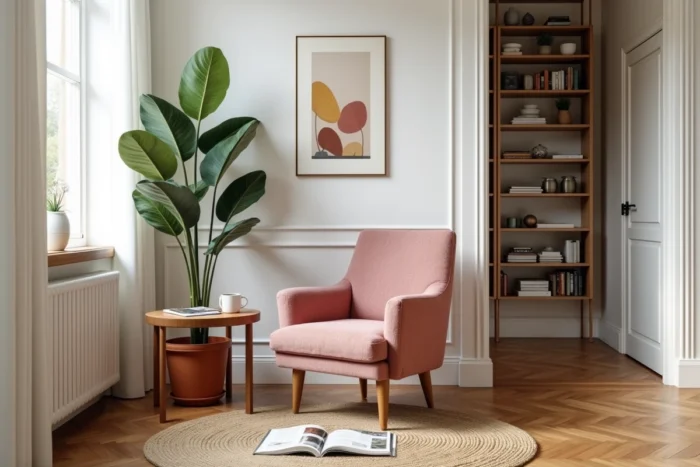
Living Room and Kitchen Decoration: The Two Rooms Where Every Euro Counts the Most
The living room and kitchen account for most of the time spent awake in a home. They are also the two rooms where visitors form an impression in just a few seconds. Focusing the decoration budget on these spaces yields the best return in daily satisfaction.
In the kitchen, the most underestimated lever is task lighting. A LED strip under the upper cabinets transforms the ambiance and comfort of use for a minimal cost. In contrast, changing cabinet facades to follow a colorful trend incurs a significantly higher budget for an effect that goes out of style in just a few seasons.
Living Room: Three High-Impact Visual Interventions
- Replacing textiles (cushions, curtains, throws) allows for a radical seasonal ambiance change without touching the structural furniture.
- Grouping lighting fixtures into three points (general lighting, ambient lighting, reading lamp) creates a visual depth that a single central ceiling light cannot produce.
- Moving the sofa away from the wall, when space allows, opens up circulation and gives a more generous sense of space.
These interventions require neither a craftsman nor a permit. They can be adjusted over the seasons and adapted to the evolving needs of the family.
The common thread of any layout or decoration project remains the coherence between structural work and aesthetic choices. First addressing thermal comfort, then organizing the space according to actual uses, and finally decorating with materials that last: this sequence avoids costly rework and quick disappointments.