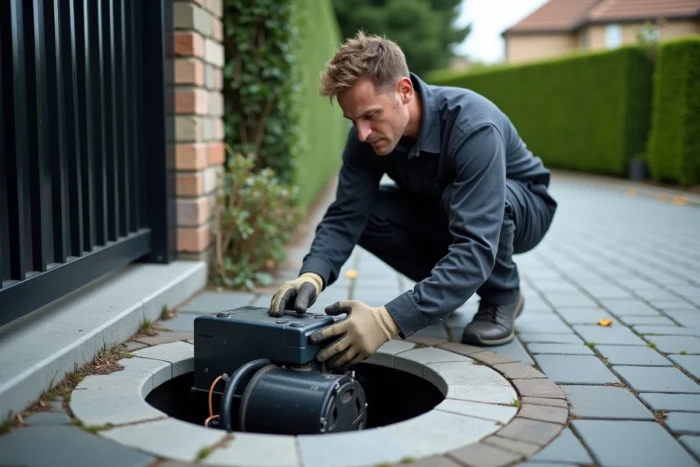
Buried automation for swing gates remains a niche segment in residential automation. Its principle is simple: an operator, hydraulic or electromechanical, is housed in a masonry pit beneath each leaf. No visible arms, no apparent cylinders. The mechanism disappears at ground level.
This type of installation is appealing for aesthetic reasons, but it involves civil engineering constraints, electrical compliance, and maintenance issues that surface-mounted solutions do not pose. Before validating this choice, one must assess what the term “buried” truly implies on-site and over time.
Masonry pit and electrical supply: what the site requires
Buried automation is not fixed to an existing pillar. It requires the creation of a concrete pit at the base of each leaf, sized to accommodate the watertight housing of the operator. This pit must withstand soil pressure, drain runoff water, and remain accessible for maintenance.
For a new gate, the pit is planned from the foundation design stage. For an existing gate, the intervention involves removing the leaves, breaking part of the slab, and sometimes reinforcing the foundations of the pillars. The additional cost compared to arm or cylinder automation is significant, and field feedback varies on this point depending on the nature of the soil (clayey, sandy, rocky).
The electrical supply adds a layer of complexity. Recent recommendations for buried gate cables require a combination of three mandatory protections: regulatory depth, TPC sheath, and warning mesh. The minimum depth is set at 85 cm whenever the cable passes under a drivable area. Trenches are often longer than with a surface-mounted system, as the route must connect the electrical panel to each pit without crossing existing networks (water, drainage).
An article detailing the specifics of buried automation helps to better understand these constraints before starting the work.
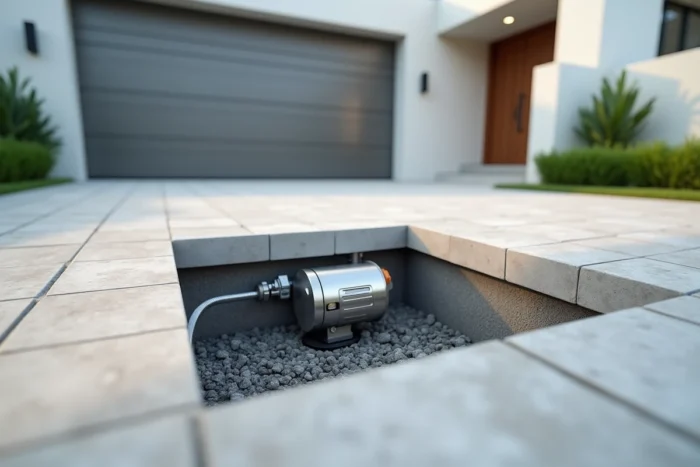
Hydraulic or electromechanical operator: two buried technologies with different logics
Not all buried motors operate the same way. Two families coexist, and the choice between them affects durability, maintenance costs, and the behavior of the gate.
Buried hydraulic cylinder
The hydraulic operator uses a pump and a pressurized oil circuit to actuate the leaf. Its pushing force is high, making it suitable for heavy gates (wrought iron, solid wood). The movement is gradual and silent.
However, a buried hydraulic circuit is exposed to temperature variations. Freezing can affect the viscosity of the oil, and a leak in the housing requires significant intervention. Reversible hydraulic operators, which allow manual operation of the gate in case of failure, are a notable advantage in this regard.
Buried electromechanical motor
The electromechanical alternative relies on a classic motor reducer. The mechanics are simpler, and the wear parts are less expensive. In return, the load capacity is generally lower than that of a hydraulic operator, which limits its use to moderately weighted gates.
The available data do not allow for a definitive conclusion on the absolute superiority of one technology over the other. The choice depends on the weight of the gate, the local climate, and the frequency of daily use.
Safety standards for motorized gates: EN 13241, EN 12453, and Labor Code
Buried automation is subject to the regulatory framework that applies to all motorized gates. The standards EN 13241 and EN 12453 impose specific safety devices:
- Obstacle detection by photoelectric cells, to interrupt closing if a person or object is in the swing area
- Sensitive edges (or touch bars) on the leaves, which stop movement upon contact
- Limitation of crushing force, measured according to thresholds defined by standard EN 12453
For mixed access (residential with employees, business entrance), Article R4214-7 of the Labor Code mandates regular inspection and maintenance of doors and gates, with an obligation for operation without risk of accident for workers. This requirement adds to the European standards and involves traceability of maintenance interventions.
For buried automation, compliance with these standards requires particular attention to the placement of photo cells. Their low positioning, at ground level, exposes them to dirt and impacts. Regular cleaning of the optics is essential to maintain compliance.

Maintenance of buried automation: access, drainage, and lifespan
Maintenance is the point that most clearly distinguishes buried automation from a surface-mounted system. While an arm motor can be disassembled in a few minutes, a buried operator requires opening the pit housing for any intervention.
The drainage of the pit is the primary factor for longevity. If water stagnates around the housing, corrosion progresses, seals degrade, and electrical connections suffer. Manufacturers recommend checking the drainage system at least once a year, ideally before the rainy season.
- Check for stagnant water in the pit and the proper functioning of the drainage
- Inspect the condition of the seals in the housing
- Test the photoelectric cells and sensitive edges
- Check the oil level and the absence of leaks (hydraulic operator)
- Ensure that the manual disengagement works correctly
The lifespan of a well-maintained buried operator far exceeds that of an arm motor exposed to the elements. Conversely, a drainage failure can drastically reduce this lifespan, sometimes in just a few years. The cost of replacing a buried operator, including potential pit reconstruction, is significantly higher than that of a surface-mounted motor.
Buried automation remains a coherent technical choice when the aesthetics of the gate is a priority and the terrain configuration allows for reliable drainage. On poorly drained clay soil or in areas with high rainfall, the maintenance constraints should be weighed carefully before pouring the first pit.