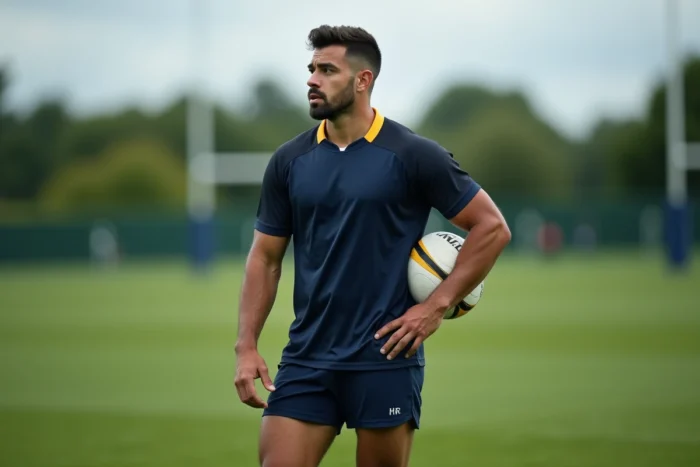
ASM Clermont Auvergne approaches the 2026 off-season with a transfer window already largely settled. The Auvergne club shows 15 arrivals for 19 departures, a balance that reflects a desire to tighten the squad rather than inflate it. With 17 contract extensions announced in parallel, the Clermont management seems to have outlined the contours of a revamped yet coherent group for the 2026-2027 season.
ASM Recruitment Strategy: Targeted Adjustment Rather Than Overhaul
Most specialized sites detail the movements player by player. What deserves more attention is the logic that connects these choices. The Clermont recruitment for 2026-2027 is part of a qualitative rather than quantitative approach. Three recruits are in the spotlight: AJ Lam, Etene Nanai-Seturo, and Darcy Swain.
The profiles of these players reveal a precise orientation. Two backs with strong wide attack capabilities, an Australian international second row to toughen up the forward pack. The club is not looking to replace departing players one for one, but to modify the technical balance of the group.
Several local sources, including La Montagne, indicate that recruitment is “presumably finished.” This means that remaining movements should be marginal, limited to end-of-window adjustments or last-minute opportunities. Rumors surrounding transfers and recruitments at ASM Rugby continue to fuel discussions among supporters, but the room for maneuver seems limited.

Departures from ASM Clermont: Positions to Watch for 2026-2027
With 19 confirmed or strongly anticipated departures, the turnover clearly exceeds the arrivals. This imbalance is not insignificant. The club is losing players in strategic positions, and some of these departures involve key players whose absence alters the sporting hierarchy well beyond a simple bench rotation.
The question is not only “who is coming” but “who is staying to provide guidance.” The 17 extensions play a stabilizing role here. They allow for the retention of a core group of players who have been trained or integrated for several seasons, which limits the risk of a locker room too destabilized by new faces.
Key Positions and Squad Depth
The forward pack concentrates some of the questions. The announced reinforcements, including Darcy Swain, bring international weight. However, the depth on the prop and back row positions remains an open topic. The available data does not allow for a conclusion on the club’s ability to absorb a series of injuries at the start of the season without weakening the rotation.
On the backline side, the arrival of profiles like AJ Lam and Etene Nanai-Seturo offers new offensive options. The fullback position seems secured after Hamdaoui’s solid season, identified by La Montagne as the position’s “mainstay.” Guillaud is presented as a candidate for the future, suggesting a medium-term succession plan.
JIFF Constraint and Salary Cap: The Invisible Parameters of ASM’s Transfer Window
Transfer lists do not tell the whole story. Two mechanisms frame each recruitment decision in Top 14: the JIFF regulation (Players from French Training) and the salary cap. These constraints often explain why a club does not recruit a player who is available, or why it lets go of a still-performing key player.
The National Rugby League recently reaffirmed its firmness on these provisions. Le Figaro reported in June 2026 that the LNR remained “firm on its principles” regarding the salary cap, marquee player, and image rights. For ASM, this means that each international recruitment (Swain, Lam, Nanai-Seturo) occupies a place in the non-JIFF quota and weighs on the salary envelope.
- The number of non-JIFF players allowed per squad is capped, forcing the club to balance between foreign recruits and locally trained or French players.
- The salary cap limits the overall payroll, making extensions for high-salary players as strategic as new signings.
- The marquee player status allows for partial exclusion of a salary from the cap, but this option remains regulated and can only apply to a limited number of players.
These parameters illuminate the recruitment philosophy for 2026. ASM optimizes its squad within a constrained framework rather than multiplying signings. The choice of targeted international profiles, combined with a high number of extensions, reflects this management under constraint.
Christophe Urios’ Ambitions for the ASM 2026-2027 Season
The sporting context also weighs on the interpretation of the transfer window. The 2025-2026 season ended in frustration, with inconsistent performances and an elimination that left its mark. Christophe Urios, the manager, has publicly stated his ambitions for the upcoming season.
La Montagne reported his statements: Urios claims to be “ambitious” for 2026-2027. This discourse contrasts with the usual caution of coaches during a rebuilding phase. It suggests that the staff considers the revamped squad capable of aiming higher than the previous season, despite a negative transfer balance in terms of player numbers.
The recurring question posed by club followers, “why does ASM falter every time it is expected,” has not found a definitive answer. The recruitment of players experienced at the international level may aim to bring that mental toughness that has been lacking in high-stakes matches.
What the Transfer Window Does Not Resolve
A recruitment, however relevant, does not alone correct collective weaknesses. The integration of new recruits into the playing system, the management of physical load over a full season, the ability to maintain a consistent level of performance: these factors depend on daily work and shared playing time, not on a transfer table.
The Clermont transfer window 2026 provides the means for renewed ambition. The answer will come from the field, starting in September, when the names on the contracts transform into combinations on the Michelin pitch.