Rephrasing a passage to integrate it into a thesis or dissertation is not just about replacing a few words with synonyms. Since 2024, several French and European universities have strictly regulated the use of paraphrasers, to the point of equating it with fraud when it is used to conceal borrowing. Understanding what these tools actually do to the text, and what anti-plagiarism software detects, changes the way they are used.
Detection by Turnitin: what paraphrasers leave as traces
Most competitors list tools without addressing the technical question that conditions everything else: how anti-plagiarism software reacts to a text rephrased by AI. Turnitin, used by the majority of French-speaking universities, has updated its detection model to identify texts processed by “humanizers” and automatic paraphrasers.
The principle relies on analyzing the statistical patterns of the text. A paraphraser produces predictable substitutions (close synonyms, subject-complement inversion, active-passive transitions) that retain a recognizable footprint. Turnitin cross-references this analysis with its database of academic and web sources.
Several technical guides published in 2024-2025 confirm that Turnitin now detects texts processed by QuillBot and other similar paraphrasers, even after several rounds of rewriting. The AI detection score displayed in the Turnitin report distinguishes AI-generated content from simply rephrased content, but both trigger a report.
Before choosing a paraphraser for your work, it is worth consulting the academic advice on Le Carolo Geek, which details acceptable uses in an academic context.
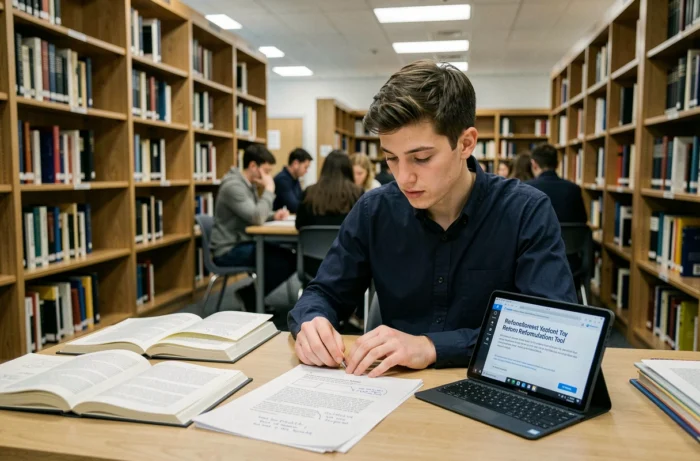
Free paraphraser and academic framework: table of allowed and prohibited uses
The distinction between legitimate use and fraud depends on the context and the policy of each institution. The table below summarizes the most common situations based on recent university regulations.
| Use of the paraphraser | Status in most universities | Risk of detection |
|---|---|---|
| Rephrasing one’s own sentences to improve clarity | Generally tolerated if declared | Moderate (detectable AI footprint) |
| Rephrasing an external source to avoid plagiarism | Considered fraud without citation | High (Turnitin cross-references source + AI pattern) |
| Using the paraphraser as a translation aid | Often allowed with mention | Low if the text is manually revised |
| Passing a text generated by ChatGPT through a paraphraser | Fraud in almost all cases | Very high (double AI reporting) |
At Aix-Marseille University, the exam charter for 2024-2025 specifies that any use of generative AI for assessed work is considered disciplinary fraud, unless explicit written permission is granted. In this case, the student must mention the tool, the scope of use, and the purpose, as with a traditional citation.
European universities such as KU Leuven and the University of Amsterdam apply a similar logic. They distinguish between AI used for learning (brainstorming, comprehension checking) and AI used to produce or rewrite a graded text. Paraphrasers are prohibited by default for assessed work at these institutions.
Rephrasing academic text: method to stay within the rules
The free paraphraser remains a useful tool as long as it is integrated into a writing process, not as a substitute. The difference lies in the order of the steps and the manual work that follows.
- First, write your own text based on the sources read and understood, then use the paraphraser to identify awkward or repetitive phrases in your own prose
- Never paste a passage from a source directly into the paraphraser to insert it as is into the thesis, as this practice constitutes disguised plagiarism even if the words change
- Declare the use of the tool in the methodological section of the work, specifying which paraphraser was used and for what task (stylistic proofreading, translation aid)
- Proofread and manually modify each suggestion from the paraphraser, as a manually revised text significantly reduces the risk of reporting by detectors

Compare suggestions before accepting
Paraphrasers like QuillBot or DeepL Write offer several rewriting modes (standard, academic, fluid). In an academic context, the academic mode better preserves the expected register in a thesis or dissertation. In contrast, the “creative” mode introduces familiar phrases that distort the scientific argument.
Each suggestion deserves a three-point check: is the meaning preserved, is the register appropriate, is the original source cited? Accepting a rephrasing without verification is like signing a text you haven’t written.
Concrete limitations of free paraphrasers for a thesis
The free versions of these tools impose constraints that directly affect the quality of academic work. Most limit the number of words per request, which forces you to break a paragraph into fragments and creates style inconsistencies between the patched pieces.
Specialized vocabulary poses another problem. A generalist paraphraser readily replaces a technical term with a common synonym that alters scientific precision. In a law thesis, replacing “prescriptive extinction” with “expiration period” changes the legal meaning.
- Free versions do not retain the history of modifications, complicating the traceability required by some university charters
- Automatic rephrasing does not manage integrated citations: quotation marks, footnote references, and bibliography remain to be handled manually
- No free paraphraser checks the argumentative coherence between rephrased paragraphs
The paraphraser does not replace human proofreading or mastery of the subject. A student who understands their source can rephrase it themselves into a clearer sentence than any algorithm. The tool is meant to polish, not to produce. Universities that tighten their rules are not targeting the technology itself, but the use that relieves the student from thinking about their text.