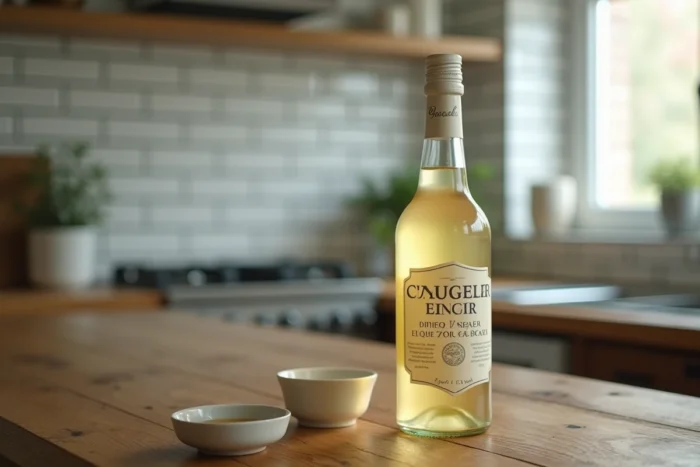
Alcohol vinegar is a condiment obtained through double fermentation: a raw material rich in carbohydrates (beet, grains, corn) first undergoes alcoholic fermentation, followed by acetic fermentation that converts ethanol into acetic acid. The finished product contains only a residual amount of ethanol, insufficient to cause any intoxication. This chemical reality is the starting point of the entire Islamic legal debate surrounding this product.
Wine vinegar, industrial alcohol vinegar, cider vinegar: three products, three sources
The most common confusion is treating all vinegars as a single product. Wine vinegar is made directly from red or white wine. Cider vinegar comes from the fermentation of apple juice. Alcohol vinegar, the one found in supermarkets under the name “alcohol vinegar” or “white vinegar,” is generally derived from beet or grain alcohol.
This distinction matters to Muslim scholars. Wine vinegar has as its raw material a product explicitly classified as khamr (intoxicating drink derived from grapes). Industrial alcohol vinegar, on the other hand, comes from ethanol that has never been a beverage intended to be consumed as alcohol. It has never passed through a state of “wine” in the Quranic sense of the term.
Contemporary opinions emphasize less the name “alcohol” on the label than the actual source of the ethanol in the production chain and the complete absence of intoxicating effects in the finished product. To delve deeper into halal alcohol vinegar according to scholars, the traceability of the raw material has become a central criterion.

Istihalah in Islamic law: does transformation change the status of the product?
The legal concept at the heart of the debate is called istihalah. This term refers to the complete transformation of one substance into another, of different nature and properties. The classic example is that of wine transforming into vinegar: the intoxicating substance disappears, replaced by acetic acid.
According to this principle, an impure (najis) or illicit (haram) substance that radically changes its chemical composition acquires a new legal status. Vinegar is no longer wine, just as a dead animal decomposing in the soil produces earth, not carrion.
Natural transformation and voluntary transformation
The divergence among scholars does not concern the principle of istihalah itself, but rather how the transformation occurs. If wine transforms into vinegar naturally, without human intervention, all legal schools consider this vinegar to be lawful. The hadith reported in Sahih Muslim, where the Prophet describes vinegar as a “good condiment” (ni’ma al-udm al-khall), establishes this consensus.
The question becomes more complicated when the transformation is deliberately induced, by adding an acetic agent or through an accelerated industrial process. Two opposing views emerge:
- The Hanafi school permits vinegar obtained through voluntary transformation. The applied rule is simple: as soon as a substance changes its nature, its legal status changes as well, regardless of the method used.
- The Shafi’i school and part of the Hanbali scholars consider that deliberately transforming wine into vinegar amounts to manipulating a forbidden substance, making the final product illicit.
- The Maliki school adopts a middle position according to the consulted jurists but tends to favor natural transformation as the only fully lawful path.
Why industrial alcohol vinegar partly escapes the wine debate
The classic debate among the four madhahib concerns wine transformed into vinegar. The alcohol vinegar sold in supermarkets poses a slightly different question: its raw material is not grape wine. The ethanol comes from the fermentation of sugar beets or grains, having never been packaged or marketed as an alcoholic beverage.
For scholars who base the prohibition on the nature of khamr (grape wine), this industrial ethanol does not fall into the same category. For those who extend the prohibition to any intoxicating substance regardless of its origin, the reasoning remains the same: ethanol is an intoxicant, so its voluntary transformation into vinegar poses a problem.
In practice, the majority of contemporary opinions consider industrial alcohol vinegar to be halal, provided that the finished product contains no significant amount of ethanol. The argument relies both on istihalah and on the fact that the raw material has never had the status of an intoxicating beverage in the strict sense.
Halal certification and label reading: concrete criteria
Halal certification bodies have evolved on this subject. The recent approach emphasizes two verifiable elements:
- The traceability of the ethanol source: does the ethanol come from wine, beer, or a non-wine raw material like beet?
- The composition analysis of the finished product: does the vinegar contain ethanol residues beyond a negligible threshold?
- The absence of illicit additional ingredients in flavored vinegars (some balsamic vinegars contain cooked grape must mixed with wine vinegar).
A white alcohol vinegar from beet without additives represents the simplest case. An industrial balsamic vinegar or sherry vinegar requires more vigilance, as the wine sector is directly involved.
The case of mustard and compound condiments
Traditional Dijon mustard is prepared with vinegar or verjuice (juice from unripe grapes). Some industrial recipes use alcohol vinegar, while others use white wine vinegar. Reading the ingredient list remains the only reliable reflex to identify the exact source of the vinegar incorporated into a condiment.
The halal status of alcohol vinegar is widely agreed upon among contemporary scholars when the raw material is not wine and the acetic fermentation is complete. The divergence mainly persists for vinegar directly derived from wine that has been voluntarily transformed, a distinct case from common industrial white vinegar. Identifying the production chain on the label remains the safest approach for a Muslim consumer in France.