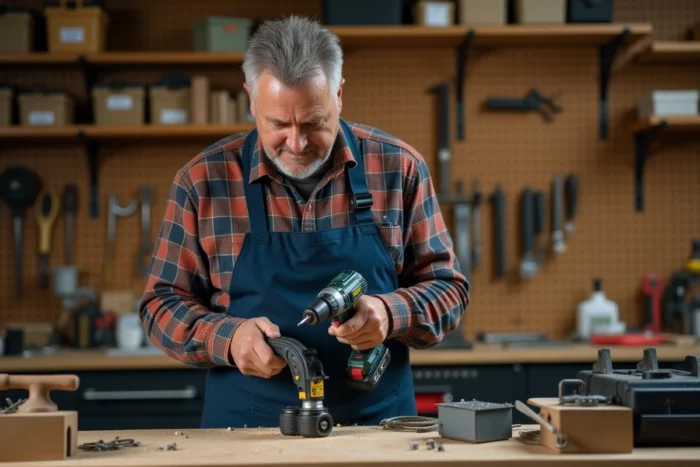
A poorly calibrated DIY tool generates more risks than it prevents. The choice of each tool and each protection relies on a prior analysis of the workstation, the materials involved, and the applicable standards. Here we address the technical points that consumer guides often overlook.
Risky materials in the home: adapt protection before touching a tool
Before selecting a mask or gloves, we recommend identifying the nature of the materials you will be working with. In a home built before the end of the 1990s, partitions, false ceilings, and ducts may contain asbestos. Older woodwork frequently has layers of lead paint. Some particle boards release formaldehyde when sanded.
These three pollutants impose very different levels of respiratory filtration. A standard dust mask is not sufficient against asbestos fibers: a single-use FFP3 mask or a P3 cartridge half-mask is required. For standard wood or plaster dust, an FFP2 is adequate. When the material cannot be identified with certainty, the rule is simple: do not intervene, or have a diagnosis performed.
We find the same logic applies to ventilation. A closed workshop where a melamine panel is being sanded quickly accumulates harmful concentrations. Opening a window does not replace an extractor fan positioned as close as possible to the source of emission. Those selecting equipment on Mulot Bricole will find useful references to match the type of work with the level of protection.
CE marking and PPE standards: what each reference means

Personal protective equipment sold in France must bear the CE marking. This marking certifies compliance with a European specification, but it does not tell the whole story. Each category of protection corresponds to a distinct standard that must be read on the packaging or on the product itself.
- Protective glasses: the EN 166 standard covers impact and splash resistance. An “F” marking indicates resistance to low-energy particles, sufficient for drilling or light grinding. A “B” marking corresponds to medium energy, necessary for use with a grinder.
- Cut-resistant gloves: the EN ISO standards define several levels of resistance (from A to F). For handling sheet metal or saw blades, we recommend a minimum level of C.
- Filtering masks: FFP2 for wood, plaster, and cement dust, FFP3 for fine toxic dust (lead, asbestos if occasional intervention is permitted). Filters have a expiration date that must be checked before each use.
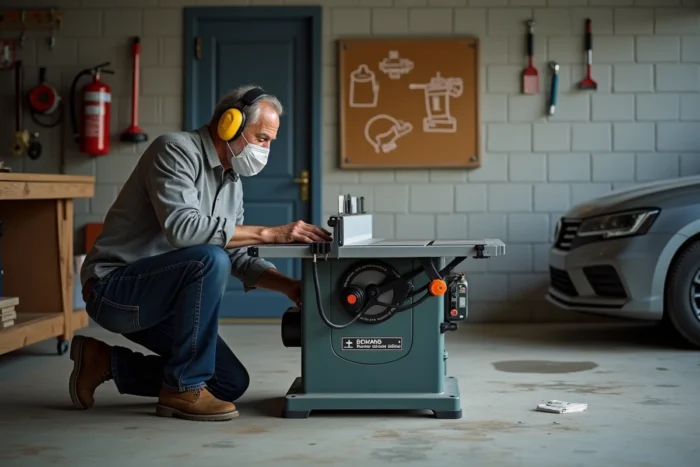
- Hearing protection: beyond a prolonged noise threshold (circular saw, hammer drill), noise-canceling headphones or molded earplugs become necessary. The level of attenuation in decibels is indicated on the packaging.
A “CE” glove without reference to a specific EN ISO standard guarantees nothing concrete. The reflex to adopt: turn the packaging over and check the pictogram as well as the associated performance level.
Power tools: safety criteria beyond power
The majority of DIY enthusiasts compare drills, saws, and grinders based on motor power or battery capacity. These parameters matter, but integrated safety devices differentiate a reliable tool from a dangerous one.
On a circular saw, the retractable lower guard must return to the closed position as soon as the blade leaves the workpiece. A blade brake that stops the rotation in less than two seconds after releasing the trigger significantly reduces the risk of accidental cuts. On a grinder, the adjustable protective guard and the screwed (not clipped) side handle are markers of serious design.
For battery-powered tools, voltage and cell technology influence thermal behavior. Quality lithium-ion packs include an electronic management circuit (BMS) that cuts power in case of overheating or short circuit. A budget pack without a reliable BMS can swell or catch fire after a shock, especially if stored in a non-ventilated workshop in summer.
We also observe that the torque setting of an adjustable chuck protects the wrists and screws better than a single-speed model. This technical detail, often overlooked, makes a difference in softwood assemblies.
Workshop organization and storage: reducing accidents before they happen
A cluttered workshop multiplies the risks of falls and cuts. The layout of the workstation directly affects safety.
Every cutting tool must have a dedicated storage location, with the blade protected. A wall-mounted pegboard allows for immediate visualization if a tool is missing, thus indicating if it is lying around somewhere. Electrical extension cords on the floor are a frequent cause of tripping: we recommend overhead reels with flap sockets.
Lighting plays an underestimated role. A single ceiling fluorescent creates shadow areas on the workbench, where the blade or drill bit operates. An adjustable lamp fixed to the edge of the work surface, with sufficient light flow, allows for precise visibility of the cutting line and keeps fingers at a distance.
The workshop floor also deserves technical attention. A smooth surface covered with sawdust becomes slippery. An anti-fatigue mat in front of the workbench stabilizes posture and limits vibrations transmitted to the joints during prolonged hammering or chiseling work.
The choice of safe DIY equipment is not just about accumulating tools and protections. It relies on understanding the materials encountered, reading the standards indicated on each PPE, and paying attention to the safety devices integrated into the tools. A well-lit, organized, and ventilated workshop does the rest.