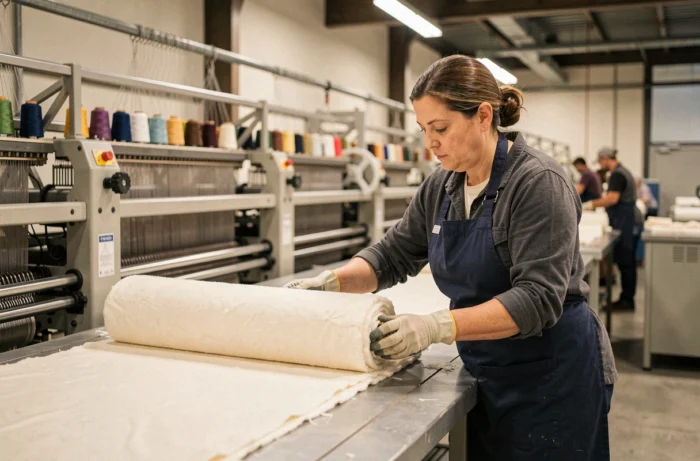
Global textile production today exceeds 130 million tons of fibers per year. Behind this volume, a transformation chain connects dozens of trades, from the cotton field to the finished fabric. The production steps of modern textiles are not limited to spinning and weaving: they now integrate recent European regulatory constraints and fine robotics technologies that reshape workshop organization.
Precision Robotics and AI: What’s Changing in Textile Workshops
The major stages of the textile sector (spinning, weaving, finishing, manufacturing) have been documented for decades. What is less documented is the wave of automation of micro-tasks affecting production lines since 2023-2024.
Systems combining artificial intelligence and collaborative robotics are taking on tasks long considered impossible to mechanize: needle threading, handling very soft fabrics, surface inspection at the thread or stitch level. These robots do not replace an entire step; they are inserted at specific points in the chain, particularly at the end of the assembly line and quality control.
Several documented cases in India show that this reorganization around robots specialized in these micro-tasks results in a measured decrease in visual defect rates and productivity gains at the end of the line. Field reports vary on this point depending on the complexity of the fabrics processed, but the trend is clear for textiles with regular weaves.
To delve deeper into the steps of textile manufacturing on Boulevard Mode, each phase is detailed with its technical specificities.
Spinning and Weaving: Two Links Where the Fiber Dictates the Process
Before any mechanical transformation, the choice of fiber conditions the entire process. Cotton, wool, silk, linen, synthetic fibers: each material imposes its own spinning parameters (twist, count, yarn regularity).
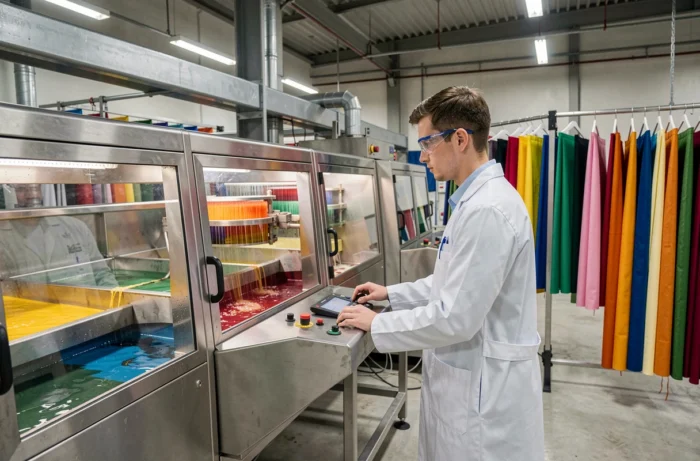
Spinning converts raw fibers into usable yarn for the subsequent stages. For cotton, this involves carding, drawing, and twisting. For wool, a preliminary wash removes grease before combing. Silk starts from a continuous filament unwound from the cocoon, which simplifies yarn production but complicates regularity control.
Weaving and knitting constitute the second major transformation. Weaving interlaces two series of threads (warp and weft) on a loom, while knitting forms successive loops. The choice between the two depends on the intended product: weaving produces stiffer and more stable fabrics, while knitting produces stretchable textiles.
Finishing: The Phase That Gives the Fabric Its Final Properties
Once woven or knitted, the raw textile is not directly usable. Finishing encompasses the treatments that give the fabric its color, texture, and performance:
- Bleaching and dyeing, which fix the color in the fiber using chemical or natural processes suited to each material
- Mechanical treatments (calendering, scraping) that modify the touch, shine, or surface density
- Functional treatments (waterproofing, anti-wrinkle, fireproofing) that meet technical specifications
Finishing often represents the most water and chemical-intensive stage in the textile chain. It is also the link where new European regulatory constraints weigh most directly.
ESPR Regulation: The New Regulatory Framework Redefining Textile Production in Europe
The European regulation on the eco-design of sustainable products (ESPR), referenced (EU) 2024/1781, came into effect on July 18, 2024. It extends the principle of eco-design to almost all physical goods placed on the European market, including textiles.
For the textile industry, this framework introduces concrete requirements that directly impact production stages:
- Criteria for physical durability (abrasion resistance, dye fastness) that the manufacturer must document
- Minimum thresholds for recycled content in certain fibers, which requires rethinking raw material sourcing
- The obligation of a digital product passport (DPP) tracing the entire life cycle, from fiber to finished product
- The prohibition of destroying unsold textiles, applicable from 2025 for large companies and 2027 for SMEs
In France, the AGEC law had already laid the groundwork with the prohibition of destroying non-food unsold goods and the extended producer responsibility for textiles through the eco-organization Refashion. The ESPR regulation harmonizes these requirements at the European Union level and strengthens them.
What the DPP Changes for Manufacturers
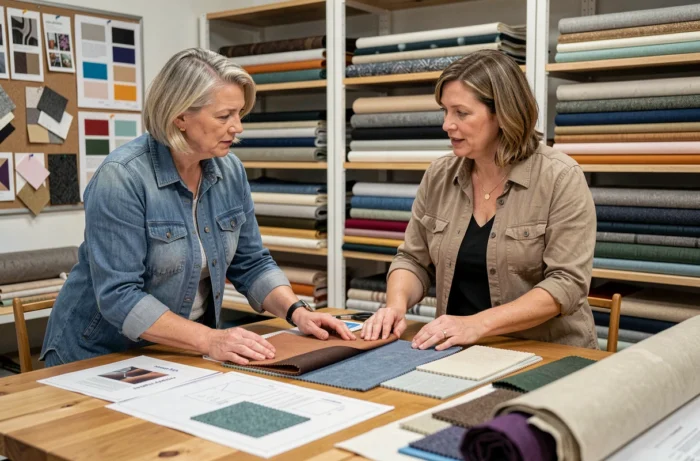
The digital product passport is not just a simple labeling. It requires each player in the chain (spinner, weaver, dyer, manufacturer) to transmit verifiable data about their portion of the process. The available data do not yet allow conclusions about the actual cost of compliance for small structures, but initial estimates suggest a significant effort in IT integration.
Complete traceability from fiber to finished garment becomes a regulatory obligation, not a marketing argument. This requires interoperable information systems among actors often located on different continents.
Manufacturing and Assembly: The Last Link Before Distribution
Manufacturing transforms fabrics into finished products. It includes pattern making (cutting pieces according to a template), assembly by sewing or thermobonding, and finishing (adding buttons, closures, topstitching). This is the stage that still mobilizes the most labor, even though automation is progressing in computer-assisted cutting and optimized placement of pieces on the fabric.
In Europe, manufacturing has largely been outsourced since the 1990s. In contrast, spinning and finishing retain facilities in France and Italy, particularly in the high-end segments (wool, silk, linen). The European textile market remains a major player on the global stage, driven by demand for technical textiles for the automotive, medical, and construction sectors.
The modern textile production chain is no longer viewed as a fixed linear sequence. The constraints of the ESPR regulation, fine robotics tools, and digital traceability requirements redistribute responsibilities among each link. The coming years will determine whether this regulatory and technological transformation benefits European manufacturers or accelerates sector concentration.