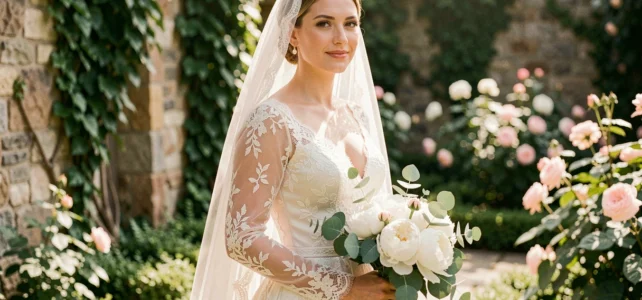
Organizing a wedding in 2026 means making choices about the format of the celebration, the dress style, and a scenography that reflects the couple. Recent trends show a shift towards more intimate ceremonies, renewed color palettes, and textile creations that move away from the classic all-white. Comparing these aspects allows us to measure what has truly changed in the way the French envision their weddings.
Micro-wedding or grand reception: what the 2026 trends reveal
The format of the wedding dictates all other choices, from the venue to the dress. Industry professionals describe a clear shift towards smaller celebrations, often spread over an entire weekend rather than concentrated on a single day.
| Criteria | Classic wedding (80+ guests) | Micro-wedding (30-50 guests) |
|---|---|---|
| Format | Single day, reception in a hall | Immersive weekend with brunch and activities |
| Budget per guest | Spread over a large number, lower unit budget | Reallocated towards the experience, higher unit budget |
| Scenography | Standardized decor, multiple vendors | Advanced personalization, strong visual coherence |
| 2026 Trend | Declining | Described as the new norm by several professional sources |
This budget reallocation changes the game. With fewer guests, couples invest more in the quality of individual services: flowers, attire, photography, private venue.
For those looking to discover the magic of weddings with Les Mariés de Sylvie, this logic of personalization is reflected in the custom approach applied to dresses and ceremony accessories.
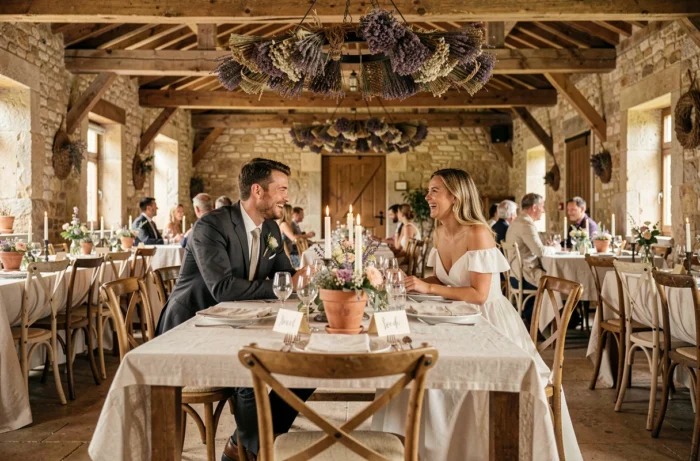
Color palettes and floral style: choices that shape the atmosphere
All-white is declining. The wedding palettes for 2026 favor warmer and more nuanced tones. According to insights from professionals in the floral and event industry, terracotta shades, sage greens, and powder pinks dominate the mood boards.
Bouquets and floral arrangements
The bouquet trends for 2026 confirm a shift towards less symmetrical, more organic compositions. Dried flowers mixed with fresh flowers remain popular, but purely dried arrangements are beginning to decline in favor of textured mixes.
- Grasses and wild foliage are gradually replacing the ubiquitous gypsophila of previous years
- Saturated colors (deep burgundy, burnt orange) coexist with pastel tones in the same bouquet
- The coherence between the bride’s bouquet and the table decor becomes a criterion of overall scenography, not just a detail
In contrast, monochrome white arrangements, long associated with classic elegance, are becoming less requested according to feedback from specialized florists. The modern wedding style now emphasizes contrast and texture.
Modern wedding dress: custom creation vs. ready-to-wear
The choice of dress remains the most emotional aspect for the majority of brides. Two approaches coexist, with very different implications in terms of timeline, budget, and outcome.
Custom creation
A custom dress requires several months of design, with successive fittings and adjustments. This process allows for the adaptation of every detail (neckline, train length, fabric choice) to the bride’s body shape and personal style.
Creations combining lace and silk remain among the most requested combinations. The mermaid cut and princess cut continue to structure the offerings, but fluid and minimalist silhouettes are gaining ground.
Ready-to-wear and alterations
Ready-to-wear bridal fashion has significantly expanded. Professional alterations transform a standard dress into a semi-custom piece, often for a budget that is half that of full custom.
The choice depends on the available timeline. A wedding planned in less than six months naturally leans towards altered ready-to-wear, while a preparation period of twelve months or more opens the door to complete creation.
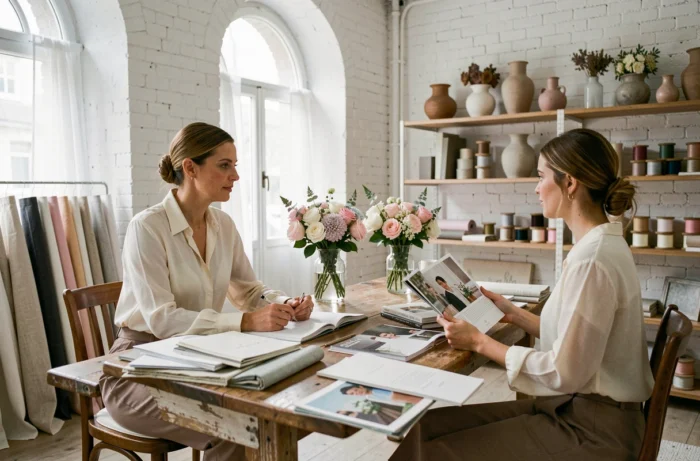
Wedding photographer and visual inspirations: what makes the difference
The wedding photographer is no longer just a documentary provider. Their visual style (reportage, editorial, film photography) directly influences the overall aesthetic perceived by the couple and their guests.
The reportage style dominates requests, with candid shots rather than posed ones. Couples seek images that tell a story rather than a catalog of portraits.
- The choice of photographer often conditions the choice of venue: natural light, architecture, surrounding vegetation
- “First look” sessions (the first glance between the couple before the ceremony) are becoming common and produce highly emotional images
- Film prints and physical albums are making a comeback against the all-digital trend, driven by a quest for materiality
The link between visual inspiration and concrete choices is direct. A couple inspired by editorial weddings like Vogue Wedding will opt for clean lines, sculptural flowers, and an architectural venue. A couple drawn to a rustic aesthetic will favor raw materials, greenery garlands, and a countryside estate.
Accessories and groom’s attire: forgotten trends
The bride’s accessories are evolving just as much as the dress itself. Classic veils are giving way to retro accessories: embellished hairpins, pearl headbands, ceremonial hats. This trend, noted by several fashion media, reflects a desire to personalize every element of the outfit.
For the groom, the three-piece suit is making a strong comeback, often in unconventional shades (midnight blue, forest green, sandy beige). The color coordination between the groom’s outfit and the overall wedding palette is becoming a criterion of visual coherence that couples work on in advance with their vendors.
Bridal shoes follow the same logic of breaking away from the classic. Sculpted heel or colored velvet models are gradually replacing standard ivory pumps, a movement confirmed by the autumn 2026 fashion selections.
All of these developments converge towards a simple observation: the wedding of 2026 is being built as a comprehensive creative project, where each element, from the dress to the flowers to the photography, responds to a unified vision rather than a list of independent vendors.