
A raw denim, a white blouse, white sneakers. The outfit works, but it doesn’t say anything special. Add a pair of geometric earrings and a braided leather belt: suddenly, the silhouette tells a story. Trendy accessories are not just there to fill a void; they direct the gaze and assert an intention. Elevating your style with accessories involves making a few precise choices, not just accumulating them.
Repairability and durability: what changes concretely for your accessories
Have you ever noticed that some bags or belts become unusable due to a broken buckle or a faulty closure? This issue has long been ignored by brands. The European regulatory framework changes the game.
The European directive on the right to repair, transposed in France in 2026, requires manufacturers to justify their claims of durability. The rules on environmental claims will apply starting from September 27, 2026. Specifically, a brand that labels a bag as “durable” will have to prove that spare parts exist and that repair is possible.
The French bonus-malus system related to repairability also pushes brands to design differently. An accessory whose buckle, clasp, or lining can be replaced benefits from a pricing advantage. For you, this means that a repairable accessory retains its value longer than a disposable product sold at the same price.
Before buying a piece of jewelry, a bag, or a belt, check if the brand offers a repair service or if the components are standard. This simple reflex prevents you from having to repurchase the same type of item every six months, and it gives more weight to each accessory in your wardrobe.
To explore pieces that hold this promise, browsing the accessory selection from Les Galeries de la Mode allows you to spot models designed to last beyond a season.

Accessories and colors: building harmony rather than matching
Matching your accessories to your outfit is a common reflex. Black bag, black shoes, black belt. The result is neat, but it lacks depth. Elevating a look involves working on color harmonies, not automatic matching.
The principle of a colored focal point
Take an outfit in neutral tones (beige, gray, navy). One single accessory in a bold color (a terracotta bag, a pine green scarf, gold earrings) creates a focal point that structures the entire silhouette. The gaze naturally directs itself toward that element.
This principle works better than a total colored look because it guides attention instead of dispersing it. A statement piece of jewelry and a vibrant bag worn together neutralize each other.
Textures rather than shades
When colors are close, play with materials. A brushed brass bracelet does not have the same effect as a polished gold bracelet, even if both are gold. Varying textures adds depth without adding color. A grained leather bag next to a smooth leather belt creates a subtle dialogue between the pieces.
Second-hand and luxury accessories: a common choice
Buying a second-hand luxury accessory is no longer a compromise. It has become a strategy adopted by buyers seeking quality, style, and resale value. Small luxury accessories (scarves, jewelry, small leather goods) are particularly sought after during times of economic uncertainty.
Authenticated resale has normalized this practice. A well-chosen second-hand accessory brings as much character as a new one, sometimes even more when it comes to a model that is no longer produced. A vintage printed silk scarf or an antique brooch tells a story that no new product can offer.
Here are some tips for smart second-hand buying:
- Check the condition of mechanical parts (clasps, buckles, hinges) before any purchase, as these determine the actual longevity of the accessory.
- Prefer platforms that offer authentication by an independent third party, not just a seller’s statement.
- Focus on timeless pieces (neutral colors, classic shapes) rather than seasonal collections, which quickly lose value.
How many accessories to wear without overloading a look
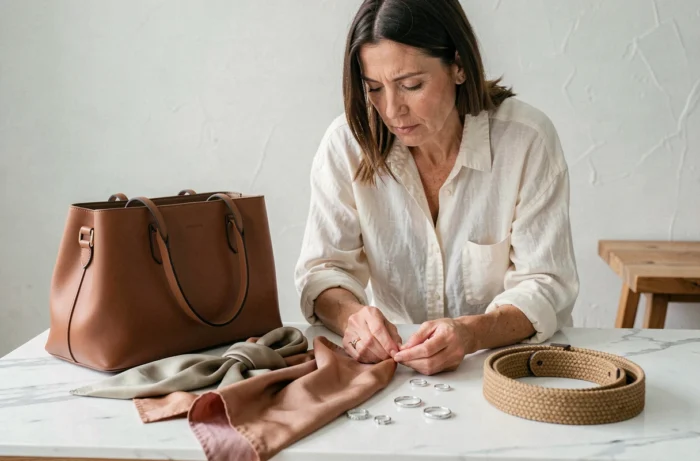
The question of dosage comes up constantly. The answer depends on the type of accessory and the occasion, but one principle remains reliable: limit yourself to three visible accessories at the same time.
By “visible,” we mean any element that the eye catches in a few seconds. A watch, a necklace, and a bag make three pieces. Adding a scarf, earrings, and a brooch brings the total to six. The silhouette becomes cluttered, and each piece loses its impact.
The dosage also varies according to the base outfit. A solid, understated dress can support more accessories than a patterned ensemble. If your outfit already has prints or details (visible buttons, contrasting seams), reduce the number of accessories to one or two.
- Simple and monochrome outfit: up to three standout accessories (jewelry, bag, belt, or scarf).
- Patterned or very textured outfit: one strong accessory, the others remain discreet.
- Party or evening outfit: focus on a statement piece of jewelry or a structured bag, not both at the same time.
This principle of subtraction produces clearer results than accumulation. Remove one accessory in front of the mirror before going out. If the silhouette remains coherent, that accessory was not adding anything.
With the future Digital Product Passport for textiles prepared by the European Commission, each accessory will eventually carry data about its composition, origin, and repairability. This type of information will make purchasing choices more precise and encourage investment in fewer, but better-designed pieces. An accessory that lasts and can be repaired replaces three disposable accessories, both in the closet and in the silhouette.