
The deductible in pet insurance determines the actual out-of-pocket expense on each veterinary bill. Before comparing the displayed reimbursement rates, it is this mechanism that sets what you will actually pay out of your own pocket. Understanding how it works allows you to assess the profitability of a contract beyond the percentage highlighted by the insurer.
Fixed, proportional, or adjustable deductible: what the plans foresee in 2026
Pet insurance contracts do not all operate on the same deductible model. Three mechanisms coexist in the market, and their impact on reimbursement varies significantly depending on the amount of the veterinary bill.
| Type of Deductible | Principle | Effect on Small Bill | Effect on High Bill |
|---|---|---|---|
| Annual Fixed | Amount deducted only once a year, at the first reimbursement | Greatly reduces the first reimbursement | Negligible over the entire year |
| Per Incident Fixed | Amount deducted for each reimbursement request | Punishing on routine consultations | Punishing as well, since applied to each claim |
| Proportional (percentage) | Percentage deducted on each act (often around 20%) | Low in absolute value | Can represent several hundred euros |
| Adjustable (customizable) | The insured chooses their deductible level to adjust their premium | Variable depending on the chosen slider | Variable depending on the chosen slider |
The 2026 trend shows a rapid spread of adjustable deductibles as a pricing lever. Some insurers now allow you to choose between no deductible, a moderate fixed deductible, or a higher deductible, with a premium that varies accordingly.
To understand pet deductibles in detail, it is important to distinguish when it applies: before calculating the reimbursement (deductible subtracted from the total amount) or after (deductible subtracted from the reimbursed amount). This nuance significantly changes the out-of-pocket expense.
Annual Deductible vs. Per Incident Deductible: Where the Real Gap Lies
The annual deductible applies only once on the first reimbursement request of the contractual year. Subsequent bills are reimbursed without additional deductions. This mechanism favors owners whose pets visit the vet multiple times a year.
In contrast, the per incident deductible penalizes each visit to the veterinarian. A dog suffering from recurrent ear infections or a cat prone to cystitis generates multiple claims annually. With a per incident deductible, each consultation incurs a deduction, even if the individual amount remains modest.
The gap becomes significant from the second or third claim in the year. A contract with an annual deductible will have already absorbed the entire deduction, while a per incident contract continues to cut into each reimbursement.
Case of Animals with Chronic Conditions
For an animal suffering from a disease requiring regular care, the annual deductible represents a net advantage. The deduction is incurred only once, and subsequent consultations are reimbursed at the agreed rate without additional cuts.
Conversely, the proportional deductible (in percentage) applied per incident can become the most costly on a major intervention. An expensive surgery combined with a percentage deductible leaves a significantly higher out-of-pocket expense than a fixed deductible of a few dozen euros.
Offers with No Deductible in Pet Insurance: The Trade-offs to Check
Several insurers are now positioning themselves on the 0 euro deductible with announced rates of up to 100% reimbursement. This commercial positioning is attractive, but comparisons published in 2026 reveal frequent trade-offs.
- Annual reimbursement caps are often lower or segmented by type of care, which limits coverage on major claims (surgery, prolonged hospitalization)
- Waiting periods remain the same as those for contracts with deductibles, sometimes several months for illnesses
- Some costly procedures are subject to specific restrictions or exclusions that reduce the real benefit of having no deductible
A zero deductible does not guarantee the best effective reimbursement. The annual cap and exclusions weigh more heavily on the overall out-of-pocket expense than a moderate deductible applied once a year.
Premium and Pet Deductible: The Slider that Changes the Monthly Bill
The deductible acts as a risk-sharing mechanism between the insurer and the policyholder. Accepting a higher deductible reduces the monthly premium. Refusing any deductible mechanically increases the contract cost.
The 2026 reports confirm that this modularity, almost absent a few years ago, is presented as a budget management tool. For a young, healthy dog, opting for a fixed annual deductible helps keep the premium low while maintaining useful coverage in case of an accident or serious illness.
Selection Criteria Based on the Animal’s Profile
- Young animal, few predictable consultations: a moderate fixed annual deductible is sufficient to keep a low premium while covering unforeseen events
- Older animal or breed predisposed to conditions: prioritize a contract with no per incident deductible, even if the premium is higher, to limit the accumulation of deductions
- Animal with a previously diagnosed chronic condition: check if the deductible applies to care related to this condition or if it is subject to an exclusion
The amount of the deductible weighs less than the annual cap on major claims. A contract with a deductible of a few dozen euros but a high annual cap offers better protection than a contract with no deductible capped at a low amount.
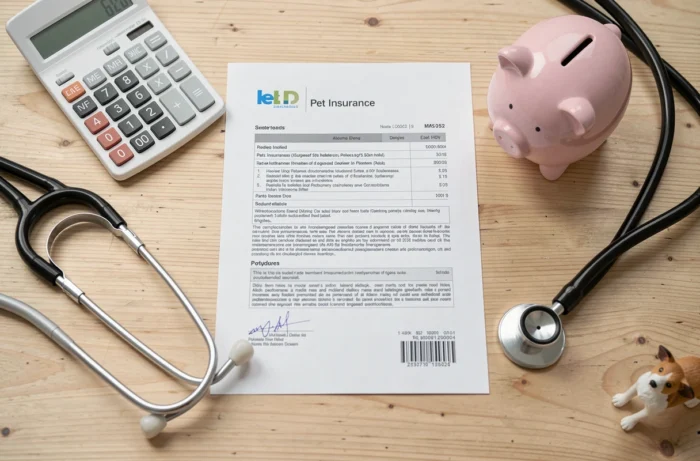
The factor that distinguishes two pet insurance contracts is neither the displayed reimbursement rate nor the absence of a deductible. It is the actual out-of-pocket expense after applying the deductible, the rate, and the combined cap. Simulating a typical veterinary bill on each considered contract remains the only reliable way to compare.